Studying. The official definition of studying is the “application of the mind to the acquisition of knowledge, as by reading, investigation, or reflection”, which I think explains the verb well. However, this definition is missing one word: draining. Even merely attending classes and listening to your professors can leave you mentally and physically exhausted, which was the main emotion I felt my first semester at Texas State.
Around the second or third month of college I realized I needed to make a change in my study habits. In high school it was easy for me to finish assignments and study because my friends were all doing the same work as me and we could collaborate together. My first semester became very difficult, very quickly when all of my assignments started piling on top of each other.
Like many other college freshman, I did not manage my time well, procrastinated and ended up extremely stressed out constantly. But, it is a new semester! This year is about being organized and doing the best we can! I have compiled a list of tips to help myself and readers on how to make the spring semester as stress-free as possible. I created the acronym C.R.E.A.M. (mainly because I was listening to that song while writing this) to illustrate the steps I am taking to appease my stress this semester.
C – CLASS ATTENDANCE
The first step to a stress-free school year is definitely attending class and taking notes. Additionally, I take notes by hand. Taking notes by hand is a great way to “study” without actually studying-you process what is being said and write it in your own terms. This helps you get a grip on the material early on and makes it easier to study from. Sometimes, teachers will even give you extra credit just for being in class on days with low attendance.
R- REGULATING YOUR TIME
During my first semester, I had two tests on the same day once and studying was catastrophic. I stayed in the library until 3 A.M. when I was asked to leave because it was closed for the night. I thought I had allotted enough time in my day to study for both of the tests-I was wrong. This semester I finally invested in a planner and has literally changed the way I operate. The “you need a planner” spiel is repetitive and I never took it seriously until college. When you write down and just acknowledge all of your assignments and due dates for the month, it helps to put things into perspective.
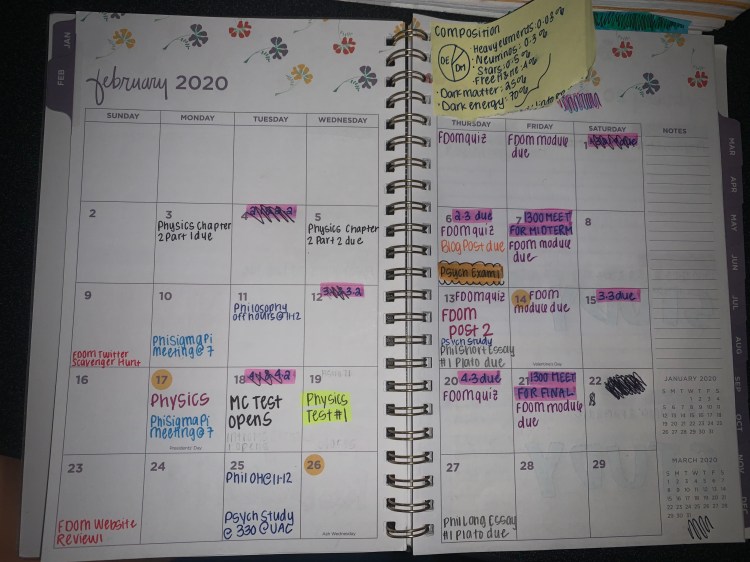
This is my planner for the month of February.
I have an online class with due dates occurring every couple of days. Without my planner I am certain I would have forgotten at least one assignment. Also, it is super therapeutic to cross out whenever you have finished an assignment. With a planner, you can brainstorm what days you need to study for assessments and see what work you can begin on days when you don’t have any homework due.
E – ESTABLISH A ROUTINE
Establishing a routine can be closely linked to regulating your time. I think of establishing a routine as a sort of muscle memory to how you plan your days. For example, every Monday, Wednesday and Friday I wake up early to eat breakfast before my first class, and every Tuesday and Thursday I know the hour and a half gap between my last classes will be spent at a dining hall. When you add in auxiliary activities like club meetings and going to the gym, eventually it becomes easy to follow your routine and you learn how to take advantage of all the free time you have designated for yourself. Writing out everything you want to accomplish in a day motivates you to complete the tasks. For example, here is a sticky note I wrote for this Wednesday…
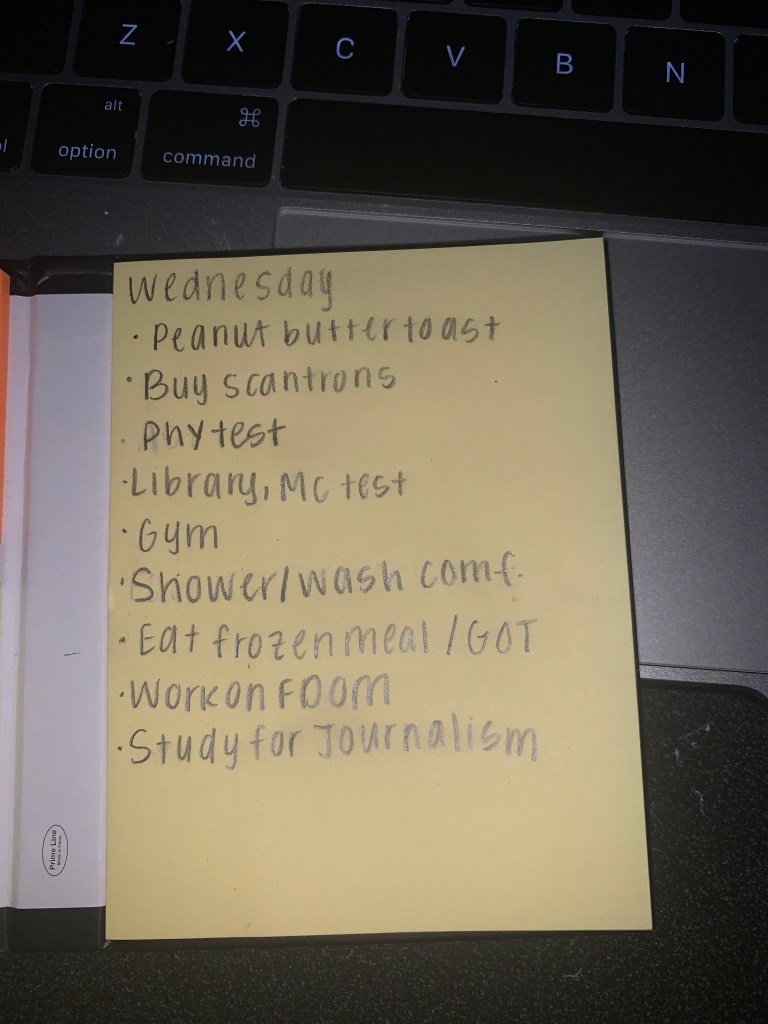
If you read the sticky note, you can see it is uber-detailed. I had to wake up earlier than usual to make my breakfast and to buy scantrons for my test. While it may seem trivial to write small tasks like that, planning it out beforehand just makes executing the tasks so much easier. I do not like the gym at all- I genuinely despise it. By writing it down, going to the gym seems less of an excusable choice and more of a concrete activity I have to complete. Overall, establishing a routine can help you destress because you form good habits that help your day run smoothly and allocating time to study can seem effortless.
A – ASAP
The most important thing I have learned about studying in college is to do it ASAP. As soon as I have all the information available for a test, I try to begin studying at least a little bit just to appease the inevitable late night cramming session I will have the day before the test. As I previously mentioned, I am taking an online class this semester. At the start of the semester, the professor released all of the assignments onto TRACS. One weekend I just sat down and completed all of them. That was one of the best decisions I have made. When I revisit my planner I see my online coursework intersecting with other quizzes I have and I am so relieved to just know that I don’t have to worry about them anymore.
Starting assignments early also allows you time to attend your professor’s office hours and ask for help or revisions. You don’t need to complete assignments weeks ahead; finishing work just one day early leaves you feeling relieved and lowkey proud of yourself!
M – MOOD
A key factor in how well you study is your environment. Some people thrive in loud, crowded places while others can only focus in the quiet floors of the Alkek. Discovering what type of environment you study best in is essential. Music is also a contributing factor to creating a stimulating mood for studying. Just like how people can vary in what environment they flourish in, people can also differ in what music helps them focus. Personally, I can only study when I’m listening to a playlist entitled “Intense Studying” by Spotify.
https://open.spotify.com/playlist/37i9dQZF1DX8NTLI2TtZa6?si=NRgK1wLFT0CUVHmn9weHbA
I hope everyone enjoyed this post! I really believe by instilling just one or two of these steps can really help destress you from the college workload.
 The Bliss in Independence